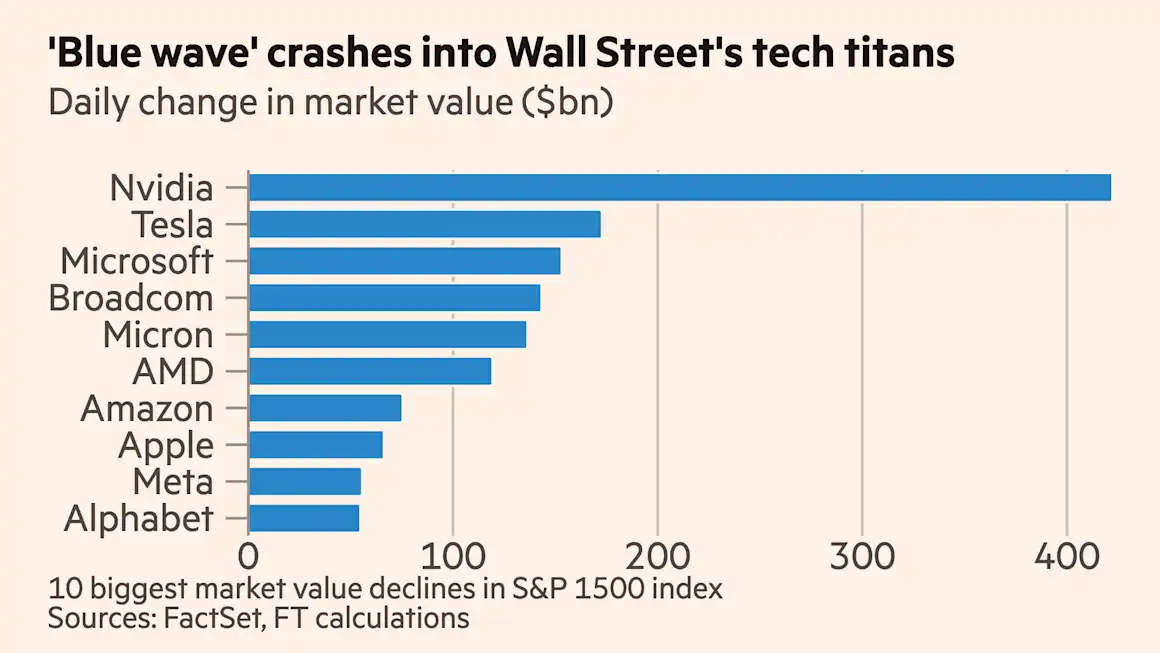
Market Collapse Driven by Political Shift and Tech Retraction
Global financial markets experienced a catastrophic downturn as the political landscape in the United States shifted decisively. The outcome of the midterm elections, characterized by a sweep for the Democratic party, served as the catalyst for a brutal liquidation event across major indices. Within the course of a single trading day, Wall Street shed approximately $3.2 trillion in total market capitalization, marking one of the most significant single-day losses in recent financial history. The speed and magnitude of the decline have shocked traders and analysts, who had largely anticipated a more gradual adjustment following the election results.
The technology sector bore the brunt of the sell-off, with the Nasdaq 100 index tumbling 6.4%. This performance represents a chaotic day of trading that highlighted the fragility of current market valuations. Investors rapidly exited positions in high-growth technology stocks, particularly those associated with the artificial intelligence boom. The rout was not limited to a single stock but affected the broader ecosystem of tech companies that had seen exponential growth in previous quarters. The sudden reversal of sentiment suggests that political risk premiums are being recalibrated aggressively by institutional investors.
Artificial intelligence stocks, which had been the primary drivers of market gains leading up to the election, faced a particularly harsh correction. The term "AI rout" has emerged in financial reporting to describe the synchronized selling pressure across major AI-related firms. Valuations that had been justified by long-term growth projections were suddenly deemed excessive in light of the new political reality. This re-pricing of risk has led to a significant contraction in the market cap of leading tech giants, contributing substantially to the overall $3.2 trillion loss. The severity of the drop indicates that the market views the Democratic policy platform as potentially detrimental to the current business models of these high-valuation firms.
Trading volumes surged to extreme levels, creating liquidity challenges for many market participants. The chaotic nature of the trading day was marked by rapid price swings and increased volatility indices. Brokers and trading platforms reported high latency and execution issues as the sheer volume of sell orders overwhelmed standard order flow mechanisms. This operational stress added to the market dislocation, as delayed executions resulted in investors selling at prices significantly lower than initial bid quotes. The incident has reignited debates about market structure resilience and the need for circuit breakers in an era of politically sensitive trading days.
Investor Sentiment and Future Outlook
The correlation between the political outcome and the market reaction underscores the growing influence of policy expectations on asset pricing. Analysts note that the Democratic sweep signals a potential shift toward stricter regulation of technology and higher corporate taxation. These policy uncertainties have prompted a risk-off environment where capital is being moved out of equities and into safer havens. The suddenness of the shift has left many portfolio managers scrambling to adjust their exposure, leading to a cascade of margin calls and forced liquidations in leveraged positions.
Looking ahead, the market is expected to remain volatile as participants digest the implications of the new political landscape. The immediate focus will be on legislative proposals that could impact the tech sector, including antitrust actions and data privacy regulations. If the regulatory environment becomes more hostile, the correction in AI and tech stocks could deepen. Conversely, if policy details remain ambiguous, a stabilization phase may emerge as investors weigh the long-term earnings potential of these companies against political risks. The coming weeks will be critical in determining whether this event is a temporary correction or the start of a broader sectoral decline.
Key takeaways
- Wall Street lost $3.2 trillion in market value in a single day following the Democratic midterm sweep.
- The Nasdaq 100 index fell 6.4%, reflecting severe pain in the technology sector.
- Artificial intelligence stocks led the decline as investors re-priced political and regulatory risks.
- Chaotic trading conditions and high volumes disrupted standard market operations.
- Market volatility is expected to persist as policy implications are evaluated.





