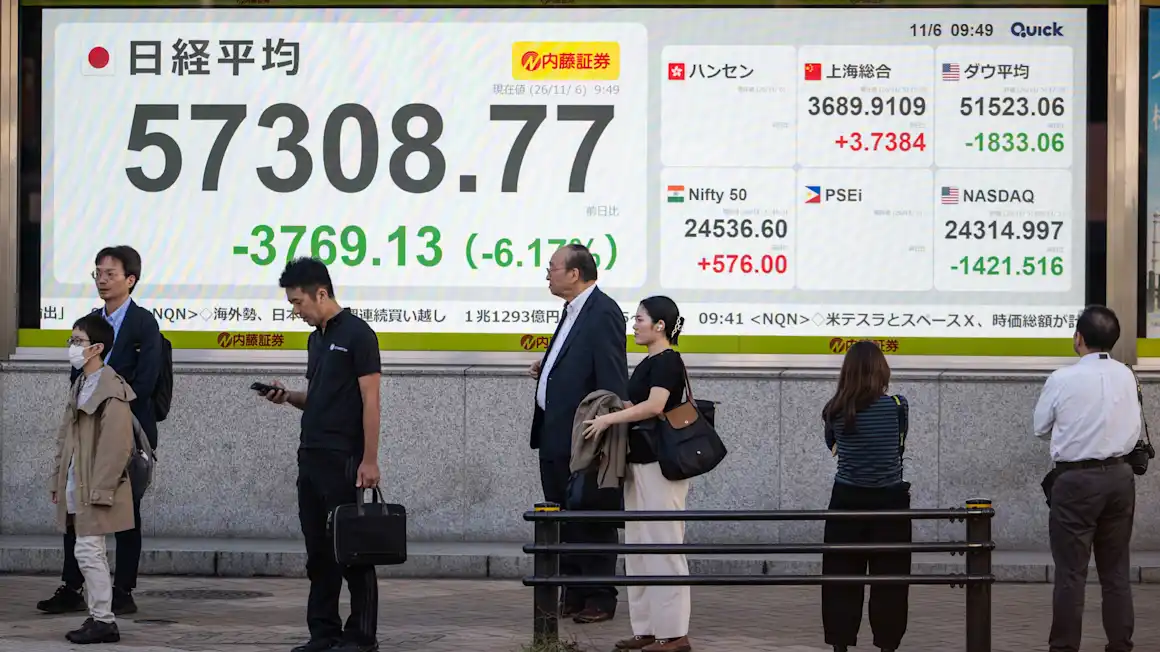
Market Turmoil Grips Asian Financial Centers
Financial markets across Asia experienced significant volatility as major indices retreated sharply, marking a turning point in investor sentiment for the region. The Nikkei 225, Japan’s premier benchmark index, dropped below the 60,000-point mark for the first time since May, signaling a substantial correction in Japanese equity valuations. Simultaneously, South Korea’s Kospi index fell under the 5,000-point level, reflecting a synchronized downturn that has impacted key technology and manufacturing sectors throughout East Asia.
The breadth of the decline suggests that the sell-off is not limited to a single sector or country but is part of a wider global risk-off environment. Investors have been rapidly exiting positions in growth-oriented assets, particularly within the technology sector, which has seen robust performance in previous quarters. This rapid unwinding of positions has led to increased volatility and heightened uncertainty regarding near-term market trajectories.
‘Complete carnage’ as Nikkei 225 falls below 60,000 points for first time since May with Seoul’s Kospi under 5,000 points
Drivers Behind the Sudden Correction
While specific triggers can vary, such broad-based declines are often associated with shifting macroeconomic expectations, changes in global liquidity conditions, or renewed concerns regarding geopolitical stability. The term 'complete carnage' used to describe the market action underscores the severity of the losses and the intensity of the selling pressure. Market participants are reassessing risk exposures as global economic data points and central bank policies continue to evolve, leading to a cautious approach among institutional and retail investors alike.
The technology sector, often a bellwether for market sentiment, has borne the brunt of the selling. High-growth tech stocks, which had rallied on expectations of sustained digital transformation and AI-driven innovation, are facing renewed scrutiny. Investors are increasingly focused on near-term earnings viability and valuation metrics in an environment where the cost of capital may remain elevated for longer than previously anticipated.
The drop in the Nikkei 225 below 60,000 points is a psychological and technical barrier that has not been breached since May. This level held significant weight for market psychology, and its breach indicates a shift in the medium-term outlook for Japanese equities. Similarly, the Kospi’s descent below 5,000 points highlights the interconnected nature of Asian markets, where sentiment in one major economy quickly spills over to others.
Outlook and Market Implications
As markets digest these sharp declines, attention turns to how policymakers and corporate leaders respond to the changing landscape. The immediate focus for investors is on identifying support levels and assessing the fundamental health of the companies most affected by the sell-off. The rapid pace of the decline suggests that algorithmic trading and momentum-driven strategies may have exacerbated the downward pressure, a common feature in volatile market environments.
Looking ahead, the resilience of the Asian tech sector will be tested as earnings seasons approach and global economic indicators are released. The current sell-off serves as a stark reminder of the cyclical nature of equity markets and the importance of diversification. While the short-term outlook appears challenging, long-term investors may view these levels as opportunities to re-evaluate portfolios and adjust strategies in line with the new macroeconomic reality.
Key takeaways
- The Nikkei 225 has fallen below 60,000 points for the first time since May, marking a significant technical break.
- South Korea’s Kospi index has dropped under the 5,000-point level, reflecting regional market weakness.
- The sell-off is characterized by severe losses across Asian tech stocks, described as 'complete carnage' by observers.
- The decline indicates a broader global risk-off sentiment impacting growth-oriented assets in East Asia.





