Wall Street Volatility Spills Over
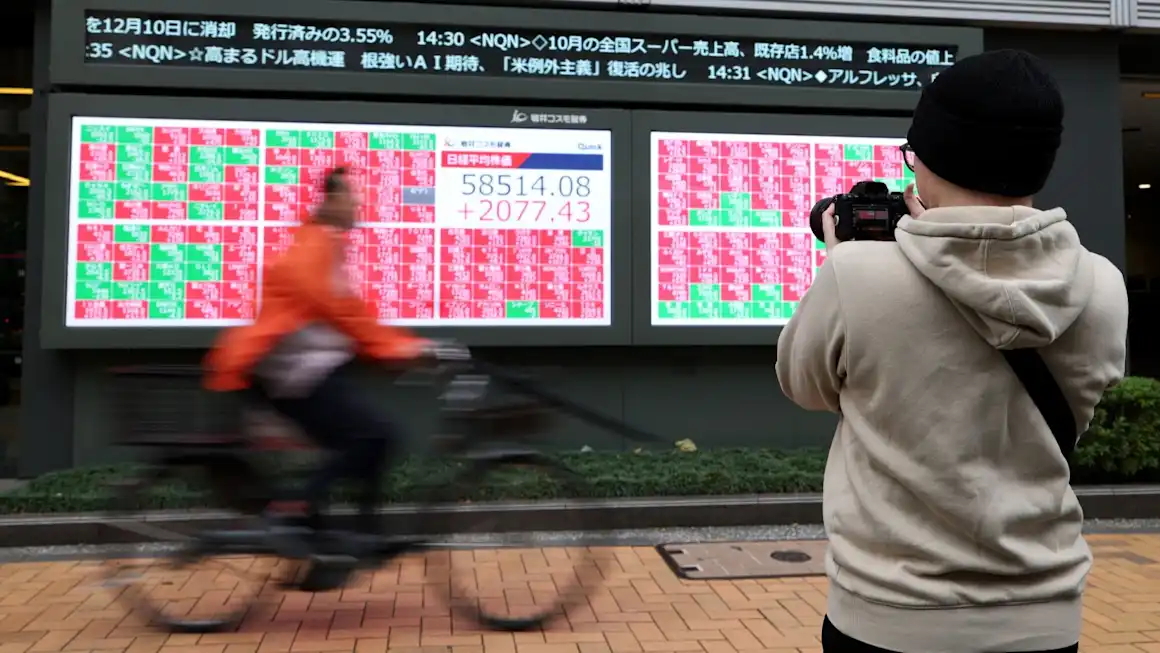
Asian equity markets experienced a broad sell-off on Tuesday as investor sentiment turned bearish, driven primarily by the tech sector. The decline mirrors a cooling of enthusiasm that had briefly lifted global markets following recent comments from NVIDIA CEO Jensen Huang. While Huang's appearance on CNBC initially sparked a relief rally across Wall Street, the momentum proved short-lived, and the subsequent fade in gains has triggered a ripple effect across international exchanges. Investors are now reassessing valuations in the artificial intelligence space, leading to a more cautious approach in the Asia-Pacific region.
Trading in Tokyo saw the Nikkei 225 index contract under the weight of heavy selling in technology-related equities. The initial optimism that had characterized the start of the trading week evaporated as traders moved to lock in profits or cut losses. The reversal highlights the fragile nature of the current market rally, which has been heavily concentrated around AI-related stocks. Without a sustained catalyst to support these valuations, the market is showing signs of vulnerability to external shocks and shifting narratives.
Seoul was not immune to the downward pressure, with the KOSPI index registering notable losses. South Korean technology firms, which are integral to the global supply chain for semiconductors and electronics, faced particular scrutiny. The correlation between US tech performance and Asian manufacturing stocks has remained tight, meaning that any hesitation in American markets translates quickly to trading floors in East Asia. The sell-off in Seoul underscores the interconnectedness of global tech markets and the sensitivity of Asian exports to shifts in US investor sentiment.
The Jensen Huang Factor and AI Skepticism
The catalyst for the recent volatility was the reaction to Jensen Huang's interview on CNBC, where the NVIDIA CEO discussed the company's outlook and the broader AI landscape. His comments initially provided a boost to the sector, leading to a temporary bounce in stock prices. However, as the day progressed and the market digested the details, the initial euphoria dissipated. This pattern suggests that while Huang's stature commands attention, the market is increasingly demanding concrete evidence of long-term profitability and growth sustainability within the AI sector.
Analysts note that the 'fade' of the Huang effect is indicative of a broader shift in market dynamics. Investors are moving away from blind optimism and are beginning to scrutinize the financial metrics of AI companies more closely. The concern is that the current valuations may be pricing in growth that is difficult to achieve in the near term. This reassessment has led to a wave of profit-taking, particularly among those who bought into the AI narrative at higher price points. The result is a market that is more sensitive to any hint of disappointment or regulatory risk.
The return of AI fears is not limited to the technology sector alone. Broader market indices have felt the drag as tech stocks, which have been the primary drivers of recent gains, struggle to maintain their upward trajectory. This shift in leadership within the market raises questions about whether the rally can be sustained without the AI theme. If tech stocks continue to underperform, it may force a rotation into other sectors, but for now, the prevailing mood is one of caution and defensive positioning.
Outlook and Market Implications
Looking ahead, market participants are closely monitoring US economic data and corporate earnings reports for signs of whether the AI boom can justify current valuations. The immediate aftermath of the Asian sell-off suggests that volatility will remain elevated in the near term. Traders are likely to adopt a wait-and-see approach, waiting for clearer signals from major tech companies regarding their AI investments and revenue streams. The fear that the AI bubble may be inflating again is a significant risk factor that could dampen investor appetite for risk assets.
The performance of Asian markets in the coming days will be crucial in determining whether this sell-off is a temporary correction or the beginning of a more sustained downtrend. If the negative sentiment persists, it could lead to further declines in tech stocks globally. Conversely, a stabilization in US markets and a renewed focus on the fundamentals of AI companies could restore confidence. However, given the current climate of skepticism, any recovery is likely to be gradual and measured.
Key takeaways
- Asian tech stocks in Tokyo and Seoul declined as the initial market rally following Jensen Huang's comments faded.
- The sell-off highlights growing investor skepticism regarding the sustainability of AI sector valuations.
- Market volatility in Asia is closely correlated with recent performance trends on Wall Street.
- Investors are shifting from optimism to a more cautious stance, focusing on concrete profitability metrics.
- The broader market is feeling the drag from the underperformance of technology-related equities.





